
How to Practice the Sabbath
I grew up in a Christian denomination that historically had strict rules about what you could and could not do on Sunday. Many of these old rules had worn away by the time I was a kid, but my father remembers being prohibited from doing homework on Sundays, playing baseball, or riding his bike. There was a host of regulations that dictated his Sunday behavior. Some of these rules were strangely arbitrary: it was okay to toss a ball back and forth with your hands but not okay to use baseball mitts, for example.
Now, I don’t want to disrespect anyone’s Sabbath practice and convictions. Hopefully, this becomes clearer below. But it is true that all these rules my father grew up with were modern reinterpretations and applications of Scripture’s Sabbath instructions.
It’s Not About Rules
We know that Sabbath observance is important—it’s in the Ten Commandments, after all (see Exodus 20:8–11)—but how exactly should it be applied or practiced today? This is something Christians of various backgrounds have differed on greatly. Years ago, I preached a sermon on the Sabbath command in a worship series on the Ten Commandments in which I surveyed different ways modern Christians have understood Sabbath practice. The main criticism I received after the sermon was, “But Pastor, you didn’t tell us all exactly what we can and cannot do on Sunday!” Truthfully, that was the point: Christians uphold their understanding of the Sabbath in many different ways.
Why Observe Sabbath
Still, we know that practicing Sabbath in some way is important. We live in a society that often operates at breakneck speed. If we aren’t careful, we’ll get sucked into those frenetic rhythms. We need to stop. We need to rest. We need to practice “non-doing.” Practicing Sabbath means we intentionally forgo making an extra buck or knocking something off our endless to-do list. We rest to remember that we don’t build our lives; they are a gift. We cease working to remember our reliance on God. Practicing Sabbath is even a way we imitate God, who rested from his work of creation on the seventh day (see Genesis 2:2–3).
In Eugene Peterson’s 1989 book, The Contemplative Pastor (Christianity Today, Inc.), he makes the striking point that one thing a good pastor should not be is “busy.” This does not mean that the pastor will not be productive or have a lot to do; it simply means that being constantly “busy” is a red flag in the pastoral calling. There must be quiet space in a pastor’s life for prayer, listening, and Spirit-led preaching. While preaching is not part of the calling of all Christians, the same principle remains: stillness and rest are required for fostering a life of prayer and a listening heart. In a chapter titled “The Unbusy Pastor,” Peterson poses the question, “How can I persuade a person to live by faith and not by works if I have to juggle my schedule constantly to make everything fit into place?” This reminds us that practicing Sabbath is a way we intentionally live by faith and not by works.
How to Keep the Sabbath
So, going back to the Sabbath instructions in the Bible itself, what are some things we can learn? Leviticus 23:3 says, “There are six days when you may work, but the seventh day is a day of sabbath rest, a day of sacred assembly. You are not to do any work; wherever you live, it is a sabbath to the Lord.”
What do we notice here? There is a regular rhythm of work and rest in our lives. If we want to put it in mathematical terms, the ratio is 6:1. That means we should still be productive and work. We don’t laze around and use the Sabbath law as justification for neglecting our responsibilities. No, there’s a directive to work right alongside the instruction to rest.
Second, it’s a practice of worship. Notice that the verse doesn’t only say to cease work. It is also to be “a day of sacred assembly.” Part of practicing Sabbath should normally be gathering with God’s people for worship. There may be certain cases where this is not possible, but gathering with a worshiping community should be the norm rather than the exception in our Sabbath observance.
Finally, connected to the idea of worship, we need to remember that the Sabbath is “a sabbath to the Lord.” It’s not “to ourselves,” but a way we point to God. It should not be a selfish practice, but a God-ward pointing pattern in our lives. Now, this does not mean that Sabbath practice is not also for our own good. As Jesus himself said, “The Sabbath was made for man, not man for the Sabbath” (Mark 2:27). While practicing Sabbath focuses us on God, it is also true that the Sabbath is a blessing—indeed, a gift—for us.
Additional Sabbath instructions in the Torah provide us more aspects to understand. For example, Exodus 23 highlights the social justice dynamic of the law: practice complete cessation from work on the seventh day “. . . so that the slave born in your household and the foreigner living among you may be refreshed” (verse 12). Not only do you not do any work yourself, but you also allow others to rest. The same verse even says work animals have the day off!
Christians will need to be creative in how they apply the principles of Sabbath practice in their modern lives. Some may be able to set aside one single day, while others may not. We must not judge one another over such differences. As Paul writes, “One person considers one day more sacred than another; another considers every day alike. Each of them should be fully convinced in their own mind. Whoever regards one day as special does so to the Lord” (Romans 14:5–6a).
The important thing is not the day on the calendar. Indeed, almost all Christians have moved the Sabbath, which was originally Saturday, to Sunday, the day on which Jesus rose from the grave. The most important thing is not the day of the week, but that we practice the principles of Sabbath in our lives as a spiritual practice of drawing closer to God and following Christ.
Aspects of that practice include intentionally ceasing from work to remember our reliance on God, advocating for justice for those around us by not putting an undue burden of work upon them, protecting their right to cease from work at certain times as well, and worshiping God in community with a group of his children.
Remember, practicing Sabbath is a God-given antidote to some of our worst human tendencies, including selfishness and pride. Sabbath shapes us into people of gratitude. God established a pause from work as a way to enact holiness in time. An intentional and routine practice of Sabbath worship and rest in our lives will constantly draw us back into God’s mercy and redemption—and there’s no better place to live!
Adapted from the study material from the NIV Application Bible based on the NIV Application Commentary series.
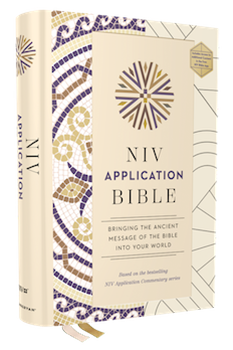
NIV Application Bible
Featuring thousands of study notes drawn from the bestselling NIV Application Commentary series, the NIV Application Bible guides you in discovering how the ancient truths found in Scripture relate to your experiences today using insight from trusted evangelical scholars, paired with timely biblical application principles.
Learn More