
Ready to Meet You in Your Mayhem
To this day, whenever I read the opening words of the Hebrew Bible, my mentor’s voice rumbles inside my head: Bereshit bara elohim et hashamayim ve’et ha’aretz.
In the beginning God created the
heavens and the earth.
Ah, those words. At the inception of all, God stands on the precipice of shaping glorious galaxies and solar systems and a baby-blue marble named Earth.
Here is the beginning of things before the beginning of things. This cosmic story elicits awe as it opens with a majestic wide-angle shot of deep darkness, then zooms in slowly: The Creator is about to create.
In the Hebrew, the word for “create” is bara, meaning “to give being to something new.” As the Spirit sweeps in, that which never was is called into existence:
Now the earth was formless and empty, darkness
was over the surface of the deep, and the
Spirit of God was hovering over the waters.
The phrase “formless and empty” is translated from the Hebrew expression tohu wa vohu, which speaks of the dark unknown of the watery deep. Though it’s tempting to think of today’s oceans and seas as vacation playgrounds and places of respite, these dreamy locales are often interrupted by devastation caused by hurricanes and typhoons and tsunamis. The unpredictable nature of the aquatic deep is nothing new.
Throughout the Old Testament, large bodies of water are often viewed as synonymous with chaos: the unknown, the mysterious, the deadly. Back then, the oceans were uncharted territory, and whether one traveled by sea or by lake, handmade watercraft were no match for a sudden storm. Beneath the water’s surface swirled a mixture of folklore and fear, tales of sea monsters and rumors of leviathans that swallowed ships whole.
The opening scene of Genesis displays a shadowy abyss representative of unmitigated pandemonium. When viewed up close like this, the language leaves one unnerved, if not terrified.
Inky blackness. Threatening chaos. Wild disarray. Tohu wa vohu.
At first glance, this feels more like a horror movie than a creation story. Imagining the seascape, something within me wants to recoil, quivering and scared. Whenever I am faced with the unknown, I tend to hesitate, to practice my well-honed avoidance skills. I have an aversion to chaos in all its forms—the chaos that reigns in the wake of heartbreaking loss, shattered dreams, or disappointments too painful to whisper aloud.
Most of us have experienced a tohu wa vohu season in life—a sudden or slow-moving or ever-accumulating devastation from which it seems impossible to recover. The confusion and chaos that ensue can cause our knees to buckle and hit the floor or make us grab our favorite squish pillow and sob until we feel lifeless and void. We desperately need an intervention, something or someone to tame the mayhem.
The Spirit waits in the wings ready to do just that—though not in the way we might expect.
The Hovering Spirit
When the Spirit steps onto the stage in the opening scene of Genesis, the Spirit doesn’t flicker in and out of the chaos of the world. Rather, the ruach Elohim—the Spirit of God—hovers over what seems untamable:
. . . and the Spirit of God was hovering over the waters.
The Spirit remains steadfast, refusing to retreat. The Hebrew word for “brooding” or “hovering,” merahephet, suggests a continuous, ongoing action, and can also mean to “flutter.” I cherish the depiction of the Spirit of God fluttering, joyously and intimately engaged with the generative process of creating.
The Spirit draws close in turmoil.
The Spirit presses into disarray.
The Spirit hovers over the uncertain and unknown.
This imagery takes shape throughout the Bible. In Deuteronomy, the way God tends to his children is compared to “an eagle that stirs up its nest and hovers over its young.”
My husband Leif and I first met in Alaska in our late twenties.
For the first five years of our marriage, we lived in Sitka and then Juneau, Alaska, where I became captivated by the eagles perching and building nests throughout our neighborhoods. Unlike other birds, male and female eagles have brood patches. These tender areas of skin underneath their bellies contain extra blood vessels near the surface, so the parents can more easily transfer heat to their eggs and newborns. Eagles sit on their eggs continually to ensure they are kept at a steady temperature.
Eaglets arrive wet and exhausted into this world, unable to see or to regulate their body temperature. They’re completely dependent on the ones who gave them life for their survival. The adult eagles overshadow their children with their wings, their very presence, to keep them alive. On hot days, the parents spread their wings to create shade, and on cold days, they wrap their wings around their chicks to keep them snuggly warm.
Like an eagle with its eaglet, the Spirit of the Living God draws near to sustain us, strengthen us, and tend to us. God wraps his wings around us and does for us what we’re unable to do for ourselves. The prophet Isaiah affirms this when he describes how, “Like birds hovering overhead, the Lord Almighty will shield Jerusalem; he will shield it and deliver it, he will ‘pass over’ it and will rescue it.” Jesus echoes this spiritual reality when he compares his longing to gather God’s children to himself to the yearning of a hen to gather her young under her wings.
The Spirit draws near in tender, compassionate, closer-than-our-next-breath ways in the midst of tohu wa vohu moments—those times when it feels like the chaos is swallowing us whole, when our dreams shatter into irreparable pieces and life makes as much sense as reading Hebrew upside down and backwards.
With the Spirit of the Living God, anything that feels formidable is far from hopeless and never final. Dare to believe it: The Spirit is ready to meet you in your mayhem.
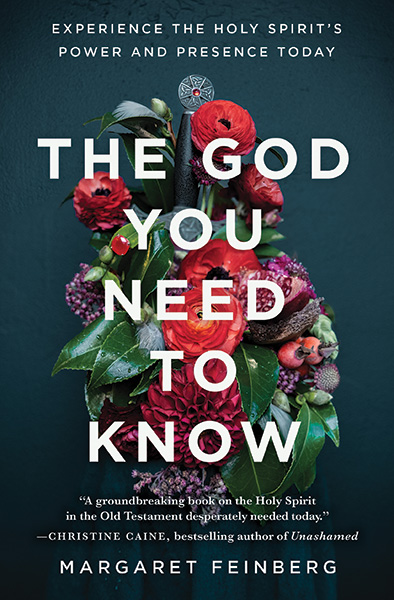
The God You Need to Know
You Believe in God. You Follow Jesus. But Does the Holy Spirit Still Feel Like a Mystery? If you’ve ever wondered why everyone else seems to have powerful Holy Spirit stories . . . but you just feel stuck, disconnected, or unsure—you’re not alone. The God You Need to Know reveals that God is neither distant nor confusing, inviting you instead to experience the real, everyday presence of the Holy Spirit who guides, empowers, and walks with you daily. You were never meant to follow God alone. The Spirit is already closer than you think.
Learn More