Lessons from the Story of Balaam and His Donkey
Any Bible story that features animals is a favorite of Sunday school lessons and children’s ministry decorations: Noah’s ark, Daniel and the lions’ den, Samson and the foxes, Jesus’ triumphal entry on a colt or donkey, and others. Perhaps we feel the presence of animals makes these stories especially interesting and relatable to young children. While it’s true that many kids love animals, the fact that these stories feature animals does not make them easy stories. A clear case in point is the story of Balaam and his donkey in Numbers 22.
When you think about odd stories in the Bible, the narrative of Balaam and his donkey will almost certainly be near the top of the list. What are we to make of this strange story featuring a talking animal? More importantly, what can Christians learn about themselves and about God by studying this passage?
The setting for this story is the wilderness wanderings of the Israelites. God delivered Israel from slavery in Egypt and made a covenant with them at Mount Sinai. As they traveled toward their ultimate destination of Canaan—a prolonged trek due to the people’s stubbornness and lack of trust in God—the Israelites frightened the nations of the lands they passed through.
In Numbers 22, the Israelites travel through the plains of Moab to camp along the Jordan River, east of Canaan. When Balak, the king of Moab, sees the great number of Israelites, he asks the prophet Balaam to curse them. God, however, tells Balaam only to do what God commands (see Numbers 22:20).
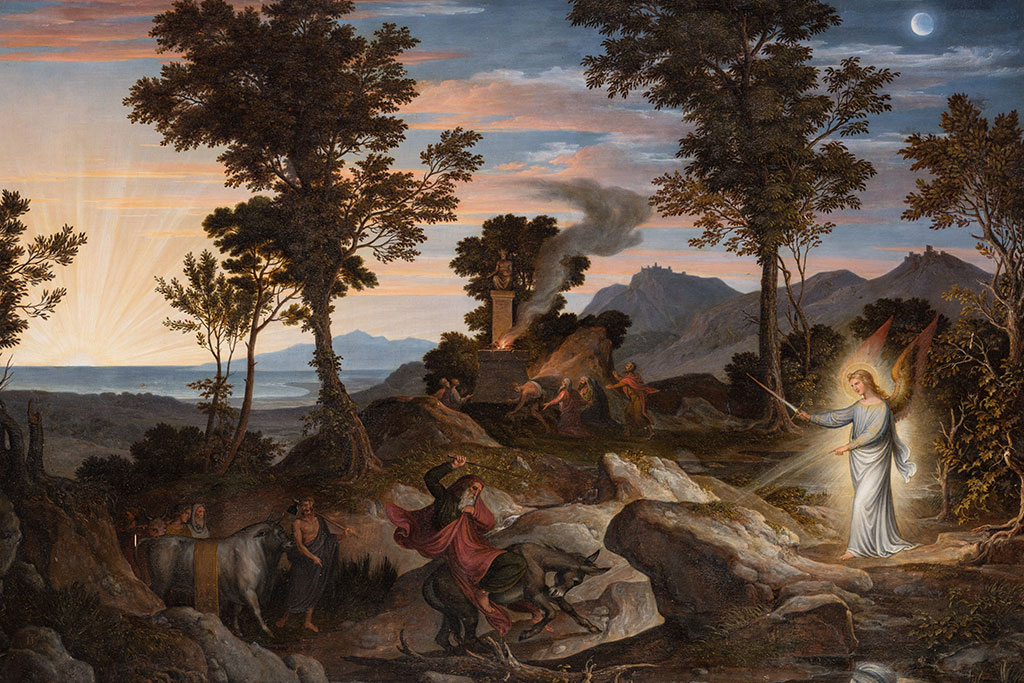
As Balaam rides his donkey toward King Balak’s summons, God’s angel stands in Balaam’s way with a drawn sword. Only Balaam’s donkey can see the angel. The donkey resists moving forward due to the angel’s presence, and Balaam beats his donkey three times for refusing to go forward. Then comes the amazing moment: “the LORD opened the donkey’s mouth, and it said to Balaam, ‘What have I done to you to make you beat me these three times?’” (Numbers 22:28).
Rather than being shocked and alarmed, Balaam argues with his donkey! Finally, God opens Balaam’s eyes to see what the donkey saw: the angel of God standing in the road with his sword drawn. Balaam finally realizes his donkey has saved his life. The angel then sends Balaam on his way with a stern warning to speak only what God tells him to speak.
When Balaam finally reaches King Balak, Balak asks him to curse the Israelites. Balak even offers Balaam a large sum of money in return. Balaam, however, speaks only what God commands. He refuses the king’s bribe to curse the Israelites. Far from cursing them, in fact, God leads Balaam to bless the Israelites three times over.
So, what does Balaam’s strange story teach Christians today? First, it reminds us that God protects his people. God promised Abraham that his descendants would become a great nation and declared, “I will bless those who bless you, and whoever curses you I will curse” (Genesis 12:3). In the story of Balaam, God does not even allow Israel’s enemies to curse them. Instead, God turns an attempted curse into a blessing. God’s protection over his people is powerful, and that truth remains a comfort and assurance for us today.
A second lesson we can learn from Balaam’s story is that God can use extraordinary and surprising means to accomplish his will. A talking donkey is an extreme example, but the story reminds us that God’s purposes will never fail. This also calls us not to think too highly of ourselves when God chooses to use us—it is all about God’s grace and power, not about our own ability or strength. After all, God could have used a donkey!
Balaam’s story also reminds us of the importance of obeying God’s will, even when there is pressure or incentive to do otherwise. Balak offers Balaam a handsome reward to curse God’s people. Balaam’s encounter with the angel, however, serves as a vivid reminder that only God’s will is worthy of full obedience. In this world, there may be peer pressure to abandon God’s instructions and “go with the crowd.” It might seem more comfortable, more rewarding, or just easier. The truth, however, is that we are ultimately accountable only to God. His will and his Word are all that matter, and he alone is worthy of our full obedience. Following God’s calling and desires for our lives may at times be difficult, but God’s blessings for his children far surpass any fleeting and empty rewards the world might offer.
As you reflect on Balaam’s story, consider which lessons are most relevant to your own life right now. Has God used surprising means to accomplish his will in and around your life? Has God shown you his amazing protection and love through difficult circumstances? Perhaps you’ve felt pressure to compromise in following God’s will and need the reminder that whatever the world offers is ultimately empty. Hopefully, you’ve come to appreciate that even this odd story tucked away in Numbers 22 has important lessons for Christians today. As the New Testament reminds us, God’s Word is living and active (see Hebrews 4:12), and “all Scripture is God-breathed and is useful for teaching, rebuking, correcting and training in righteousness, so that the servant of God may be thoroughly equipped for every good work” (2 Timothy 3:16–17). This includes even the strangest stories; God’s Word offers treasures everywhere!
Adapted from the study material from the NIV Application Bible based on the NIV Application Commentary series.
NIV Application Bible
Featuring thousands of study notes drawn from the bestselling NIV Application Commentary series, the NIV Application Bible guides you in discovering how the ancient truths found in Scripture relate to your experiences today using insight from trusted evangelical scholars, paired with timely biblical application principles.
Learn More