The Baptism of Jesus and the Call to Transformation
The Gospels of Matthew, Mark, and Luke each describe a pivotal moment at the Jordan River—a quiet, yet powerful event that would signal the beginning of Jesus’ public ministry and the dawn of a new era in God’s redemptive plan.
The baptism of Jesus is more than a ceremonial act; it is a divine revelation that invites us into deeper understanding, purpose, and transformation. In Jesus’ baptism, we witness God’s plan for our own personal transformation into people who follow his will and his way.
The Scene at the Jordan
Let’s begin by visualizing this profound moment as recorded in the three Synoptic Gospels. First, we’ll look at the account in Matthew, then look at the differences in the accounts in Mark and in Luke:
Then Jesus came from Galilee to the Jordan to be baptized by John. But John tried to deter him, saying, “I need to be baptized by you, and do you come to me?”
Jesus replied, “Let it be so now; it is proper for us to do this to fulfill all righteousness.” Then John consented.
As soon as Jesus was baptized, he went up out of the water. At that moment heaven was opened, and he saw the Spirit of God descending like a dove and alighting on him. And a voice from heaven said, “This is my Son, whom I love; with him I am well pleased.”
— Matthew 3:13–17
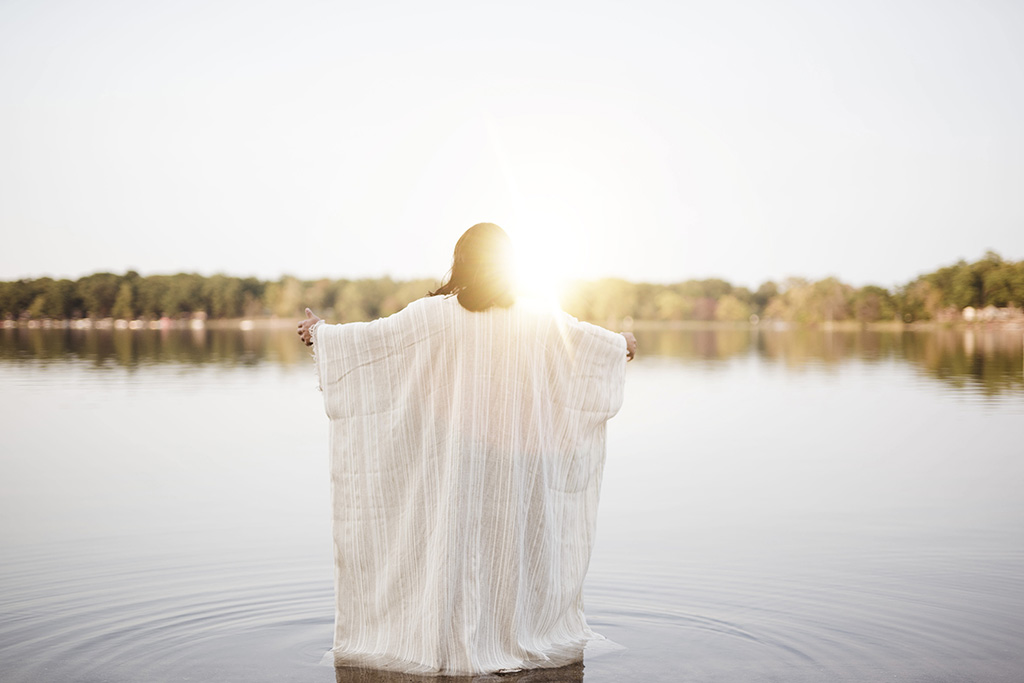
The Son of God begins His ministry not with miracles or public proclamations, but with humility. In obedience to the call from John the Baptist for people to confess their sins and repent, Jesus, the sinless one, steps into the murky waters of the Jordan. John the Baptist himself, knowing who Jesus was and what he came to do, objected to this almost absurd request. But Jesus insisted, recognizing the call to obedience as his critical part in God’s plan.
Jesus joined the crowd of sinners obediently stepping into the waters of baptism, but he didn’t do it because he himself needed cleansing. No, he did it to set for us an example of what we need to do. We need to be cleansed. Here Jesus, though sinless, identified with the broken, the outcast, and the weary. He entered the human situation and story not as a distant deity, but as Immanuel—God with us (Isaiah 7:14; Matthew 1:23).
In coming to John for baptism, Jesus submitted not just to a ritual, but to the will of the Father. His baptism is a powerful symbol of His coming mission: to live among us, to carry our burdens, and ultimately to die in our place. The humility of this moment reminds us that the path to greatness in the Kingdom of God begins with surrender.
Heaven Was Torn Open
Mark’s account gives us a similar, but slightly different perspective on the events of this day:
At that time Jesus came from Nazareth in Galilee and was baptized by John in the Jordan. Just as Jesus was coming up out of the water, he saw heaven being torn open and the Spirit descending on him like a dove. And a voice came from heaven: “You are my Son, whom I love; with you I am well pleased.”
— Mark 1:9–11
All three Gospel accounts describe a miraculous moment when heaven was opened. In Mark’s vivid language, it is “torn open.” This is not a gentle parting of the clouds, but a noticeable, significant, dramatic unveiling. This young man wrote his Gospel after listening to Peter’s eyewitness accounts of this moment. He adds the dramatic language signaling this as a divine event—one that likely awed and possibly frightened the people who saw it happen.
This opening of heaven, and the verbal proclamation that follows, signifies more than divine approval—it is a signal that the barrier between God and humanity is beginning to break. For centuries, prophets spoke of a coming Savior. At the Jordan, the Savior that has come to fulfill all prophecy, the One who will move the plan of God forward, stands in the water. At this, heaven itself cannot remain silent.
Mark’s description allows us to imagine the sights and sounds of God’s stratospheric response to his Son’s humble act.
The Descent of the Spirit
Luke gives us another look at this beautiful event, signifying two more things from the event that many people witnessed:
When all the people were being baptized, Jesus was baptized too. And as he was praying, heaven was opened and the Holy Spirit descended on him in bodily form like a dove. And a voice came from heaven: “You are my Son, whom I love; with you I am well pleased.”
— Luke 3:21–22
Luke the doctor relates that as Jesus is coming up out of the water, he prays. What might Jesus have been saying to his heavenly father as he came up after being baptized by his relative John? The Bible doesn’t give us an answer, but we can observe this, as all of the other gathered people did, as a holy and significant moment between the Son and the Father. Jesus here openly and gratefully submits to God’s will for his life, understanding that the path forward will be difficult. But he knows that his heavenly Father will accompany and be with him every step of the way.
Here Luke also records that the Holy Spirit descends “in bodily form” like a dove—a symbol rich in meaning. The dove’s flight recalls how the Spirit hovered over the waters in Genesis, a reminder of creation (Genesis 1:1-2) that points to a moment when the Father, Son, and Spirit were also seen together. The dove also symbolizes peace and the movement away from God’s judgment, as it did for Noah and his family when the dove came back to the ark with an olive branch in its beak (Genesis 8:6-12).
Again, when in Luke’s account we see the Spirit “in bodily form,” we understand that this event was not merely a vision or metaphor. It was a visible and audible confirmation for Jesus, for John, and for the crowd. God’s presence was no longer abstract; it had come to dwell among us in the person of Jesus and now rested upon him in the Spirit.
This same Spirit is later promised to all believers. What began at the Jordan River becomes a model for the Christian life: humility, obedience, the infilling of the Spirit, and the affirmation of our identity as God’s beloved.
The Voice from Heaven
Each of the three synoptic Gospels records a voice from heaven affirming Jesus’ divine identity:
“You are my Son, whom I love; with you I am well pleased.”
This descent marks Jesus as the Anointed One, the Christ, and empowers him for the ministry ahead. These words echo Psalm 2:7 and Isaiah 42:1, both prophetic passages pointing to the Messiah. But beyond theology, these words strike at the core of every human heart. In a world that constantly demands that people prove their worth, Jesus receives divine affirmation before he preaches a single sermon or performs a single miracle.
God declares his pleasure not in what Jesus has done or is yet to do, but in who he is: God’s own Son. What a powerful truth for those of us who follow Jesus. Our identity in Christ begins not with our achievements, but with God’s love. Through faith in Jesus, we too become sons and daughters of God. And over our lives, God longs to speak the same words: “You are mine. I love you. I am pleased with you.”
The Power of Obedience
There’s a quiet, often-overlooked truth in this story: Jesus obeys. He steps into the water even when John protests. He walks a path that leads not to applause, but to the cross.
This is the paradox of divine greatness. In a culture that elevates independence and self-promotion, Jesus teaches us that the greatest power is found in obedience and submission to the Father’s will. That is a critical lesson for the billions who have decided to follow Jesus since his ministry on earth.
The Gospel of John Illuminates the Story
John, the disciple of Jesus who wrote the fourth Gospel decades after the other three Gospel writers, made sure that those who had heard and read about Jesus’ baptism in the other Gospel accounts would understand its significance. John relates the story of Jesus’ baptism through the words and the experience of John the Baptist, who witnessed all of these things and understood Jesus’ critical mission to the people of God.
Now this was John’s testimony when the Jewish leaders in Jerusalem sent priests and Levites to ask him who he was. He did not fail to confess, but confessed freely, “I am not the Messiah.”
They asked him, “Then who are you? Are you Elijah?”
He said, “I am not.”
“Are you the Prophet?”
He answered, “No.”
Finally they said, “Who are you? Give us an answer to take back to those who sent us. What do you say about yourself?”
John replied in the words of Isaiah the prophet, “I am the voice of one calling in the wilderness, ‘Make straight the way for the Lord.’”
Now the Pharisees who had been sent questioned him, “Why then do you baptize if you are not the Messiah, nor Elijah, nor the Prophet?”
“I baptize with water,” John replied, “but among you stands one you do not know. He is the one who comes after me, the straps of whose sandals I am not worthy to untie.”
This all happened at Bethany on the other side of the Jordan, where John was baptizing.
The next day John saw Jesus coming toward him and said, “Look, the Lamb of God, who takes away the sin of the world! This is the one I meant when I said, ‘A man who comes after me has surpassed me because he was before me.’ I myself did not know him, but the reason I came baptizing with water was that he might be revealed to Israel.”
John the Baptist knew and understood the significance of this moment in the life of the nation of Israel. He saw Jesus as the One who would come to transform the state of humanity and make a way for people to have their sins forgiven once and for all time. He also understood that he was a part of that plan, adding to the significance of this event.
A Call to Remember Our Baptism
Though Jesus’ baptism was unique in its divine significance, it also invites us to reflect on our own. In Romans 6:4, Paul writes: “We were therefore buried with him through baptism into death in order that, just as Christ was raised from the dead through the glory of the Father, we too may live a new life.
Baptism is more than a ceremony—it is a sign of the individual recognizing that the old, sinful self needs to die. In submitting to baptism, the individual is sometimes dipped under water, where even a short time under the surface would guarantee literal death. In being raised from the water, the one being baptized testifies to the reality of Jesus’ resurrection to new life—and in fact, the resurrection that will happen one day when Jesus comes again on the clouds (see Matthew 24:30; Revelation 1:7).
Again, Jesus did not need to be baptized to repent from his own sin, as he was sinless every millisecond he lived on this earth. Instead, he chose to be baptized for us. In doing so, He dignified the waters, making them a path of grace for all who follow Him.
Do you remember your baptism? Whether it was long ago or recent, this was your Jordan moment—your identification with Christ in his humility, his obedience, and his resurrection power.
If you haven’t yet been baptized, the invitation remains open. The same Spirit that descended on Jesus now waits to fill you. The same heavens that opened for Him still open for every soul who turns to God in faith.
What Heaven Speaks Over You
Pause for a moment and imagine those words—spoken over Jesus—being spoken over you:
“You are my son or daughter, whom I love; with you I am well pleased.”
In Christ, this is more than imagination—it is reality. When you trust in Him, you are adopted into God’s family. His Spirit dwells in you. Your life has purpose, value, and eternal significance.
At your baptism, you may not have seen the heavens “tear open,” or seen an actual dove alight, or heard an audible voice, but God’s Word affirms the truth of your submission to his will. It gives insight into the truth of your identity in his eyes. The same Father who rejoiced over his Son at the Jordan now rejoices over you—with singing (Zephaniah 3:17)!
Enter the Waters Again
The baptism of Jesus is not some dusty event locked away in the pages of Scripture. Rather, it’s a living invitation. It’s an invitation to humility. To obedience. To Spirit-filled purpose. To an identity that is firmly rooted in God’s love for you as his child.
When Jesus stepped into the Jordan, the water did not change him—but he changed the water. He sanctified this humble act for all who would follow in his footsteps. He turned the water of baptism—whether that is in a swimming pool, in a baptismal in a church sanctuary, or in some muddy tributary of an anonymous river—into a river of divine grace.
Wherever you are on your journey—doubting, weary, or thriving—remember your Jordan moment. Or prepare for it. God’s voice still speaks. The Spirit still descends. And heaven still opens over those who say yes to Jesus.
God declared that Jesus was his beloved son—his child, his treasure, the one who pleased him. And through a declaration of your faith in him, so are you. Please never forget that amazing fact: the almighty God has chosen to adopt you into his actual family! And all you have to do to join that family is to say “yes.” As Romans 10:9 says, “If you declare with your mouth, ‘Jesus is Lord,’ and believe in your heart that God raised him from the dead, you will be saved.”
If you are looking for a new Bible or your first one, find an NIV Bible that’s right for you! There’s an NIV Bible for every age and need – Bibles for study, devotions, journaling, classic reference, large print, youth, and more. Find yours today!