
How Do You Unify People Who Disagree About Everything?
Pastor John had been wanting to visit Transformation Church for a while. After sitting through a Sunday morning gathering, he looked at me, genuinely puzzled, and asked: “How have you done this? How do you get people from different ethnic backgrounds, generations, and social classes to be unified?”
“There’s a reason Sunday morning is still the most segregated time of the week,” I said. “But not here.”
“Why?”
“Because of the gospel of King Jesus.”
It is our biblical conviction that Jesus didn’t just die on the cross and rise from the dead to forgive our sins. His redemption also creates a family made up of every skin color (Ephesians 2:14-16). This multiethnic, worldwide family is rooted in God’s covenant with Abraham, where he promised to build a family from every ethnic group on earth (Genesis 12:1-3).
Paul puts it this way in Galatians 3:8: “Scripture foresaw that God would justify the Gentiles by faith, and announced the gospel in advance to Abraham: ‘All nations will be blessed through you.'”
Jesus is the Seed of Abraham who brings this family into existence through his redemptive work (Gal 3:16, 26-29). Individual salvation exists so God can have his redeemed, multiethnic family, exactly as he promised long ago (Ephesians 2:12).
Why a Multiethnic Church?
When my wife and I co-founded Transformation Church in 2010, we built the vision on the book of Ephesians. Paul writes this letter to an ethnically diverse group of people from different backgrounds and different political persuasions, showing them how to live in and from the unity Jesus gave them because of the gospel:
This mystery is that through the gospel the Gentiles are heirs together with Israel, members together of one body, and sharers together in the promise in Christ Jesus (Ephesians 3:6).
To certain Jews of the first century, those words would have landed as an insult (Acts 10:28), that a Gentile could be an heir, a member of the same body, a co-recipient of Abraham’s promise. The irony is that Abraham himself was a Gentile. There were no Jews until he and his sons fathered the Jewish nation from which the Messiah would come.
Paul calls himself a servant to this gospel. For him, it did more than save people from hell. It brought dead people to life in Christ so they could become the unified people of God, displaying his character on earth (Ephesians 4:1-6; 5:8-10).
Five Gospel Truths From the Book of Ephesians
Ephesians gives us five gospel truths that shape the church in the present to reflect what it will be in the new heaven and new earth.
First, God’s multiethnic church is alive in Christ. Ephesians 2:1-6 tells us that Jew and Gentile alike are born spiritually dead, and it’s God who makes us alive through the gospel. The gospel isn’t bad people becoming good. It’s dead people becoming alive with resurrection life in Christ.
Second, God’s multiethnic church embraces God’s grace. Grace isn’t only unmerited favor. Grace is Jesus being everything we could never be, presenting us to the Father holy, blameless, righteous, and pure (Ephesians 1:3-14; 2:8-9). Our religious devotion doesn’t put us in God’s grace. Our ethnicity doesn’t put us in God’s grace. Only Jesus does (Ephesians 2:8-9).
Third, God’s multiethnic church knows Jesus is our peace. Peace with God and peace with one another were purchased on a bloody cross. Jesus broke down the dividing wall between Jew and Gentile and created a new humanity out of Jews and Gentiles (Ephesians 2:14-16). Our ethnic distinctions aren’t erased. They’re celebrated, because our differences bring out the best in each other. God’s people aren’t color-blind. We’re color-blessed.
Fourth, God’s multiethnic church is a worshiping church. Paul uses temple language to describe how God’s people now have access to the Father through the life, death, and resurrection of Jesus. The temple was where heaven and earth met, where sacrifices for sin were made, where praise rose to God. Now God’s people, together, are that temple, worshiping him as “living sacrifices” (see Romans 12:1).
Fifth, God’s multiethnic church walks in the way of love. Paul wrote, “Follow God’s example, therefore, as dearly loved children and walk in the way of love, just as Christ loved us and gave himself up for us” (Ephesians 5:1-2). The multiethnic church only flourishes through love. Love leads to personal holiness and corporate virtue (Ephesians 5:3—6:20). Love that looks like the cross is the power that unifies God’s diverse people (Ephesians 3:16-21).
The Future Is Now
In the future, every nation, tribe, and tongue will sing to King Jesus in one voice:
And they sang a new song, saying: “You are worthy to take the scroll and to open its seals, because you were slain, and with your blood you purchased for God persons from every tribe and language and people and nation. You have made them to be a kingdom and priests to serve our God, and they will reign on the earth.” (Revelation 5:9-10)
That beautiful, life-giving future can break into the present, because the gospel reconciles us to God vertically and to each other horizontally.
It can happen.
How do I know? By God’s grace and a lot of love, we’ve lived this beauty and unity for sixteen years at Transformation Church.
And so can you.
By Dr. Derwin Gray, adapted from Ephesians: Life in God’s Diverse Family.
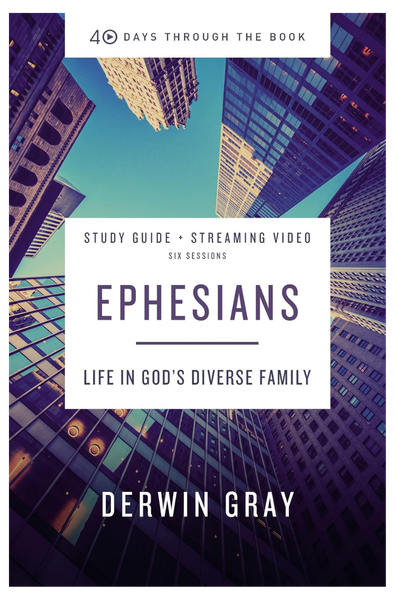
Ephesians: Life in God’s Diverse Family
The message of the gospel that Paul brought to the culturally diverse city of Ephesus forever transformed its citizen’s lives. But the church in Ephesus had the same problems we face today: it was a multiethnic group of believers who found it difficult to come together as one and put aside their differences. In this six-session study (streaming video included), pastor Derwin Gray of Transformation Church, Charlotte, NC, takes you and your group through Paul’s letter to the Ephesians to reveal how the apostle presented the revolutionary idea that Jesus came not only to forgive sins but also to create a unified family out of a diverse people.
Learn More