
New Every Morning: Why Your First Thoughts Matter More Than You Think
Your eyes haven’t even opened yet, and your mind is already running.
Did I forget something important? What’s waiting for me today? Why does it feel like I’m already behind?
Before your feet hit the floor, you’ve replayed yesterday’s failure, previewed today’s stress, and rehearsed a worry or two you haven’t even earned yet.
If that sounds familiar, I want you to know two things right away: you’re not alone, and you’re not stuck.
And while those first thoughts may feel automatic, they don’t have to determine the rest of your day.
Most of us assume the real battle starts sometime around lunch, when the emails pile up or a conversation goes sideways. Scripture says it starts much earlier, before any of the challenges arrive.
Nearly two thousand years ago, the apostle Paul wrote, “Do not conform to the pattern of this world, but be transformed by the renewing of your mind” (Romans 12:2). Paul understood something we’re still catching up to: real, lasting change doesn’t happen through sheer willpower. It happens as we allow God to reshape the way we think, which then changes the way we live.
Both Scripture and science, it turns out, agree on exactly when that renewal is most likely to take root: first thing in the morning. I’ve actually come to believe that when renewal begins may be just as important as the renewal itself.
A Coach, a Sprint, and a Phrase I Couldn’t Shake
I don’t remember the first time I heard the phrase “win the morning.” I give the credit to my junior high soccer coach, who insisted our practices happen before school instead of after. We’d show up bleary-eyed as the sun was rising, and he’d line us up for sprints, hollering with William Wallace-level intensity, “Win the morning! Win the morning, boys, and you win the day!”
Most of us were merely tolerating the morning. I remember thinking, Why can’t we just win the morning back in bed?
But over the years, I’ve discovered there’s real wisdom buried in that sweaty, exhausted memory. The thoughts we think first thing in the morning set a pattern that tends to run through the rest of our day. Whether we take those thoughts captive — or let them take us captive — has a way of determining whether we react to our day or respond to it.
What the Bible Says About the Morning
The heroes of our faith seemed to understand this. Scripture is full of people who met God first, before anything else could get a word in:
- Abraham rose early in the morning to worship (Genesis 22:3).
- Moses “went up… early in the morning” to meet with God (Exodus 34:4).
- Job made it his habit to rise “early in the morning” and intercede for his children (Job 1:5).
- Isaiah wrote of God waking him “morning by morning” to teach him (Isaiah 50:4).
David, in particular, seemed to build his spiritual rhythm around the morning:
- “In the morning, Lord, you hear my voice; in the morning I lay my requests before you and wait expectantly” (Psalm 5:3).
- “Let the morning bring me word of your unfailing love, for I have put my trust in you. Show me the way I should go, for to you I entrust my life” (Psalm 143:8).
Then there’s Jesus, in the middle of a busy, demanding season of ministry: “Very early in the morning, while it was still dark, Jesus got up, left the house and went off to a solitary place, where he prayed” (Mark 1:35). If the Son of God felt the need to meet with the Father before the day’s demands arrived, how much more do we?
Science Confirms What Scripture Already Knew
Here’s where it gets interesting. When I first noticed this biblical pattern, I wondered if there was anything behind it beyond good spiritual discipline. It turns out there’s a growing body of neuroscience that backs it up.
Researchers describe the hour or so after you wake as a kind of “neuroplasticity window.” Your brain moves through several wave states as you rouse, and during that transition it is unusually receptive to new information and new patterns of thought. Sleep and stress researchers have also found that our stress hormone, cortisol, tends to peak in the morning hours. That means our morning thoughts carry extra emotional weight; they leave a deeper imprint than the thoughts we have at, say, 2:00 in the afternoon.
There’s also a psychological principle called priming. Think of it like a coat of primer on a wall before you paint. You can’t see it once the color goes on, but it changes everything about how that color looks. In one well-known study, researchers asked one group of students to spend five minutes imagining life as a university professor, and another group to spend five minutes thinking about soccer, before giving both groups a set of trivia questions. The professor group significantly outperformed the soccer group. They weren’t smarter. They’d simply been primed.
Your first thoughts of the day are priming you for everything that follows. If you reach for your phone the moment you wake, scrolling headlines and comparison before your feet even hit the floor, you are priming your brain for distraction and reactivity. If instead you reach first for God’s Word and a few honest minutes of prayer, you are priming your brain for truth, peace, and perspective.
Paul’s command to “renew your mind” wasn’t just good theology. It was, we’re discovering, good neurology. The fascinating thing is that Scripture understood this long before neuroscience had a name for it.
Jeremiah’s Worst Morning: What He Chose to Think
Jeremiah wrote the book of Lamentations after watching Jerusalem, his home, his people, everything he loved, be destroyed. He’d warned this would happen, and no one had listened. Now he stood in the wreckage, grieving. Lamentations is, structurally, an alphabet of grief: four of its five chapters are Hebrew acrostic poems, Jeremiah working his way through the alphabet, letter by letter, cataloguing everything that had gone wrong.
But sandwiched in the middle of all that lament is a hinge: “Because of the Lord’s great love we are not consumed, for his compassions never fail. They are new every morning; great is your faithfulness” (Lamentations 3:22-23).
Notice what Jeremiah does first. He doesn’t pretend everything is fine. Scripture never asks that of us. He starts honestly: “I well remember them, and my soul is downcast within me” (Lamentations 3:20). He brings his real grief to God. But he doesn’t stay there.
In the middle of the worst morning of his life, he makes a decision: “Yet this I call to mind and therefore I have hope” (Lamentations 3:21).
Those words change everything. Jeremiah isn’t saying the ruins have disappeared, and he isn’t pretending the grief is gone. He’s saying, in effect, here is what I choose to remember, on purpose, right now. That’s the hinge the whole book turns on: not denial, but direction.
There’s a real difference between expressing our pain to God and rehearsing it on a loop. Jeremiah expresses it. Then he chooses, deliberately, what he’ll dwell on instead.
Notice, too, what he chooses to remember, morning by morning:
God’s compassions never fail. The Hebrew word behind “compassion” carries the picture of a mother’s womb: fierce, tender, protective love. And Jeremiah says these compassions are “new every morning.” The word “new” here means more than another serving of the same supply. It means a fresh, custom-built mercy for whatever today requires.
Great is his faithfulness. Whatever today holds, whoever lets you down, whatever doesn’t go the way you hoped, God’s faithfulness isn’t contingent on any of it.
The Lord is my portion. Jeremiah says it plainly: “I say to myself, ‘The Lord is my portion; therefore I will wait for him’” (Lamentations 3:24). He was writing about a people who were starving, trading their last possessions for a bite of bread. And still, the Lord was enough.
If Jeremiah could take his thoughts captive on the worst morning of his life, we can do it on an ordinary Thursday.
A Simple Way to Start Tomorrow
Transformation rarely begins with dramatic changes. More often, it begins with about ten intentional minutes and a willingness to give God your first thoughts before you give them to your phone. So what does this actually look like tomorrow morning?
1. Resist the reflex to reach for your phone first. Let your brain wake up before you flood it with headlines, notifications, and everyone else’s highlight reel.
2. Be honest with God about what today holds. If it’s a hard season, say so. Lament isn’t a lack of faith. Jeremiah shows us that. Bring your real feelings before you try to rearrange them.
3. Choose what you’ll call to mind. Something like: God’s compassions are new for me this morning. Great is his faithfulness. The Lord is my portion. Say it out loud if you can—there’s something powerful about hearing truth in your own voice.
4. Spend a few minutes in Scripture and prayer. Even five minutes of intentional truth beats zero minutes. Remember, this is less about perfection and more about direction.
Missing a day doesn’t erase your progress. Grace, not guilt, is the fuel for lasting change. Just begin again tomorrow.
The Canvas You’re Handed Every Morning
Every morning, God hands you fresh, wet paint. Yesterday’s picture is finished. Today’s canvas hasn’t been touched yet. The only question is what you’ll paint.
You can pick up anxiety and splash chaos across the page. You can pick up comparison, convinced everyone else’s life looks like art while yours looks like a mess. Or you can pick up the colors God is holding out to you: the gold of his mercy, new every morning; the blue of his faithfulness, steady as the horizon; the green of his provision, abundant and alive.
Jeremiah sat in the ruins of everything he loved and still picked up God’s brush to paint hope. Tomorrow, when your alarm buzzes and your feet hit the floor, you’ll face the same choice he did: your phone, or God’s Word. Give him the first few minutes. Let him fill your heart with love, your mind with truth, and your day with purpose.
Win the morning, and watch God win your day.
If this resonates with you, I explore this idea further, along with forty-two days of Scripture, practical steps, and real stories of transformation, in a devotional called Win the Morning, a companion to my book Every Thought Captive, on taking every thought captive and renewing your mind one morning at a time.
By Kyle Idleman based on content from his book Win in the Morning.
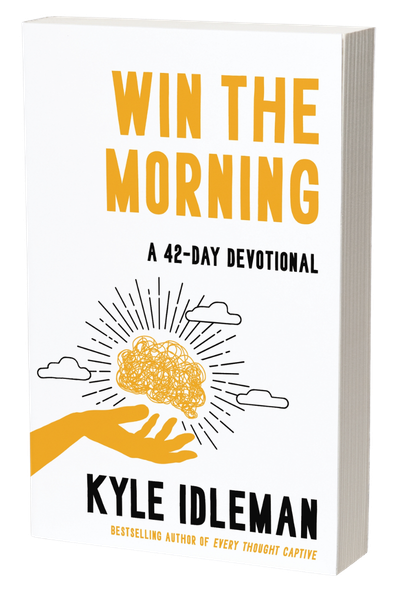
Win in the Morning: A 42-Day Devotional
Your mind can be renewed, and renewal happens best in the morning. Kyle Idleman invites you to give God the first moments of your day and allow him to shape your thoughts, your focus and your heart. As you begin each day in his presence, you’ll learn how to recognize unhealthy thought patterns, take your thoughts captive and invite God’s truth into your mind, replace lies with Scripture and rewire your thinking to align with God’s Word, and solidify new mental pathways through practical mind exercises and focused prayer.
Learn More