
Right Where You’re Supposed to Be
If Martin Luther, the famous German Reformer, had had his way, you probably never would have heard of Esther. Martin Luther was one of a number of biblical scholars who weren’t quite sure what to make of Esther, the exiled Jewish teenage girl who became the queen of Persia. They’ve suggested that her story, perhaps, doesn’t even belong in the Bible. Why? Because it’s messy.
Esther’s book poses some troubling questions, such as:
- Why are Esther and her people still living in the Persian capital, Susa, decades after God had opened the doors for them to return to Israel?
- Why is God’s name never mentioned—not even one time—in the whole book? Is that some kind of indication of how disconnected these Assyrian-dwelling Israelites are from God?
To help you keep the timeline straight: Esther’s story took place about forty years after Daniel’s ended. Zerubbabel, Ezra, and Nehemiah had all led groups back to their homeland according to Jeremiah’s prophecy (see Jeremiah 25:11–12) and God’s command (see Ezra 1:1–4). They’d experienced God’s miraculous provision in doing so. God moved on King Cyrus to pay for a lot of this, and he supernaturally protected Nehemiah during the reconstruction of Jerusalem’s walls. Back in the land of Judea there had been revivals in which faithful Hebrews read Scripture over the old temple mound twenty-four hours a day for several days straight.
Esther was part of a group that stayed in Persia, however. And we don’t quite know why. Jews back in Judea at the time accused this group of being soft traitors, of getting too comfortable in captivity and forgetting where they were truly from. And, honestly, it’s hard to say they were wrong. God had told them the exile was over and it was time to go home. Some may have felt compelled to stay for practical reasons, but it’s still hard to understand why so many didn’t go home. God had reopened the door to the promised land!
Then, through a series of interesting, if not disturbing, events, Esther found herself as the new queen of this pagan empire. I won’t fully go into it, but King Xerxes, head of the Persian empire (the empire that took over for the Babylonians), hosted a fifth-century-BC version of The Bachelor, and Esther won. If you think I’m exaggerating here, go read it! It’s one of the craziest stories in the Bible.
This raises questions about whether Esther should have been in this contest. It was an inherently immoral contest, and Esther had to conceal her Jewish identity to enter it. Of course, Esther likely had little choice in the matter, as Jewish refugee girls in the fifth century BC didn’t have much agency. Then again, Joseph, a slave in Potiphar’s house in Egypt, didn’t have much choice when Potiphar’s wife commanded him to sleep with her, and Joseph went to prison for his refusal (see Genesis 39). Should Esther have done the same? Tough questions.
The Rest of the Story
Long story short, after Esther won the contest, her story took an interesting turn. She found out about a plot by Xerxes’ chief of staff, Haman, otherwise known as the Dwight Schrute of Persia, to kill all the Jews there. Mordecai, Esther’s older cousin and confidant, told her that she needed to do something to stop it. Esther said, “All the king’s officials and the people of the royal provinces know that for any man or woman who approaches the king in the inner court without being summoned the king has but one law: that they be put to death unless the king extends the gold scepter to them and spares their lives” (Esther 4:11).
Mordecai’s response: “Do not think that because you are in the king’s house you alone of all the Jews will escape. For if you remain silent at this time, relief and deliverance for the Jews will arise from another place, but you and your father’s family will perish. And who knows but that you have come to your royal position for such a time as this?” (Esther 4:13-14).
Let me cut to the chase: Esther risked her life to save her fellow Jews, and ultimately she prevailed. Not only did she save the lives of thousands of Jews, but many Persians—including King Xerxes himself—recognized the hand of God in it all and gave honor to him.
In this instance, I’m glad Martin Luther didn’t have his way, because Mordecai’s words to Esther have provided a challenge to exiles in every generation, and they are especially poignant in ours: Perhaps you’re here for just such a time as this?
God has us here for a purpose. Maybe the path getting us here hasn’t been pretty. We might be tempted to analyze whose fault it is that we are here. But the primary question for us to ask is this: What does God want from us now?
For what purpose has God brought us into this Babylonian kingdom at just such a time as this?
A Theology of Place?
Heather Holleman, a committed Christian and literature professor at Penn State, says that Christians today need to recover a “theology of place.” A theology of place, she says, is an awareness that, wherever you are, God placed you there for an Acts 1:8 purpose.
Paul referred to this theology of place, Holleman says, in Acts 17, when he said to a bunch of Greeks living in Athens: “From one man he made all the nations, that they should inhabit the whole earth; and he marked out their appointed times in history and the boundaries of their lands. God did this so that they would seek him and perhaps reach out for him and find him, though he is not far from any one of us” (Acts 17:26-27).
In other words, God sovereignly arranges the borders of nations so that people in those nations will have the chance to seek him. If God does that with whole nations, Holleman says, then surely we can be confident he is doing that with our own personal “borders,” too. God has appointed our personal dwelling places so that others around us can hear about God through us and seek him because of us.
That’s how it worked with Daniel, after all. Nebuchadnezzar thought he’d merely conquered Judah. Unwittingly, he turned Babylon into a huge mission field.
You are in that profession, or living in that neighborhood, or residing in that particular hall, or sitting next to that particular person, for a reason. Your successes and failures put you into contact with particular people whom God is seeking. Holleman challenges Christians working in secular places to ask the question “What do you see?”
Who is there?
What needs do you see?
What questions are they asking?
What crises are they in?
Where might God be at work?
Wherever you are, God has determined your place—the borders of where you live and who you know. He has sovereignly directed the choices, successes, and failures that brought you here. He did that because he’s at work in the people around you, putting questions and problems in their lives so that they might seek him. And he brought them up next to you.
Open your eyes and join him.
By J.D. Greear
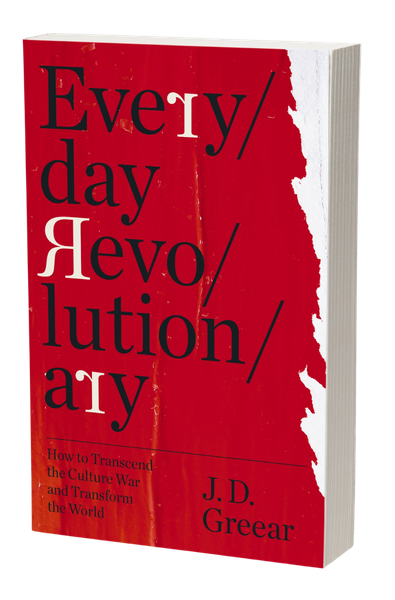
Everyday Revolutionary
Pastor and Bible teacher J. D. Greear calls us to reimagine our Christian witness in today’s world. Written for those of us who feel like outsiders in this new era, Everyday Revolutionary draws on the story of Daniel to help us get excited about sharing the Good News with colleagues and friends, find the courage to face opposition from all political extremes, take inspiration from Scripture on how to minister in modern Babylons, and discover core practices that strengthen faith under fire.
Learn More